




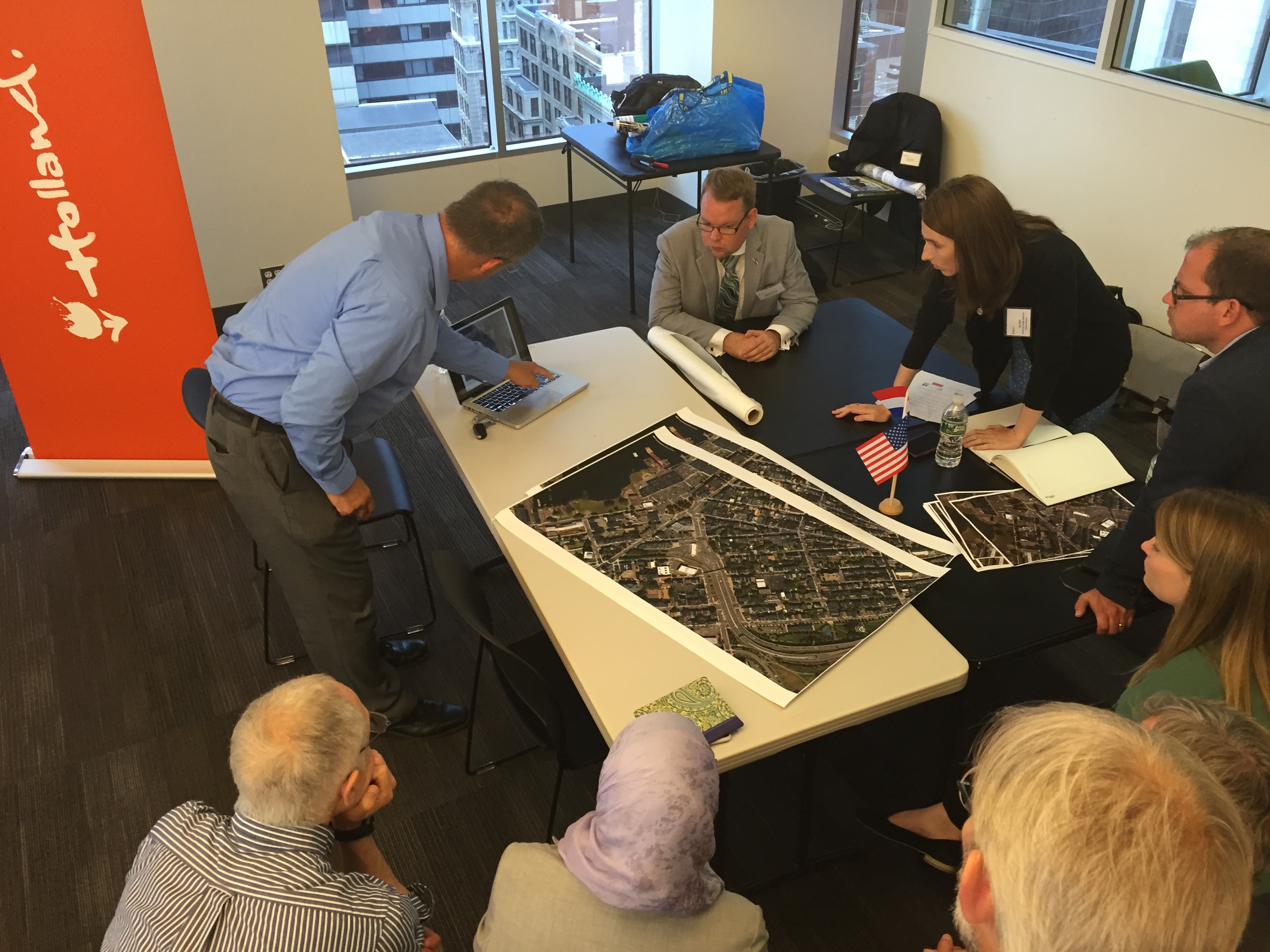
Participants in the Urban Metabolism Workshop talk about the Sumner Tunnel Toll Plaza in East Boston.
By Carter Craft
Senior Economic Officer, Consulate General of the Netherlands in New York
@NLinNY
Cities are living organisms. The people, whether they are residents or commuters, and the systems surrounding them, both natural and human-made, all bring life to a city.
These elements interact with each other constantly. In the process, they contribute to and feed off the surroundings.
As elements within this system we rely upon and simultaneously help to sustain it.
The world is entering a new era of the city. Population is growing, and migration has brought more than half of the world’s residents to urban areas. This shift is creating an imbalance.
The interactions between our built and natural systems are becoming in some ways less predictable and more complex.
How can we ensure that the metabolism of cities stays healthy and productive?
Recently, a diverse mix of nearly 100 practitioners, policymakers, students, researchers and leaders came together to look at Boston’s “Urban Metabolism.”
Discussions ranged from how it has and continues to change to what direction it may go in the future.
The culminating event of the Wetskills Boston 2016 student program, the Urban Metabolism Workshop included plenary session in the morning followed by roundtable discussions in the afternoon. For a report and the presentations from the morning sessions click here.
The afternoon session explored Boston’s urban metabolism at three scales: site, district, and region (I will write about the latter two soon). Key characteristics of each area were introduced by group leaders, then a facilitator and designer helped to map out a better understanding of each area’s vulnerabilities as well as different strategies for addressing them.
Site: Sumner Toll Plaza, East Boston
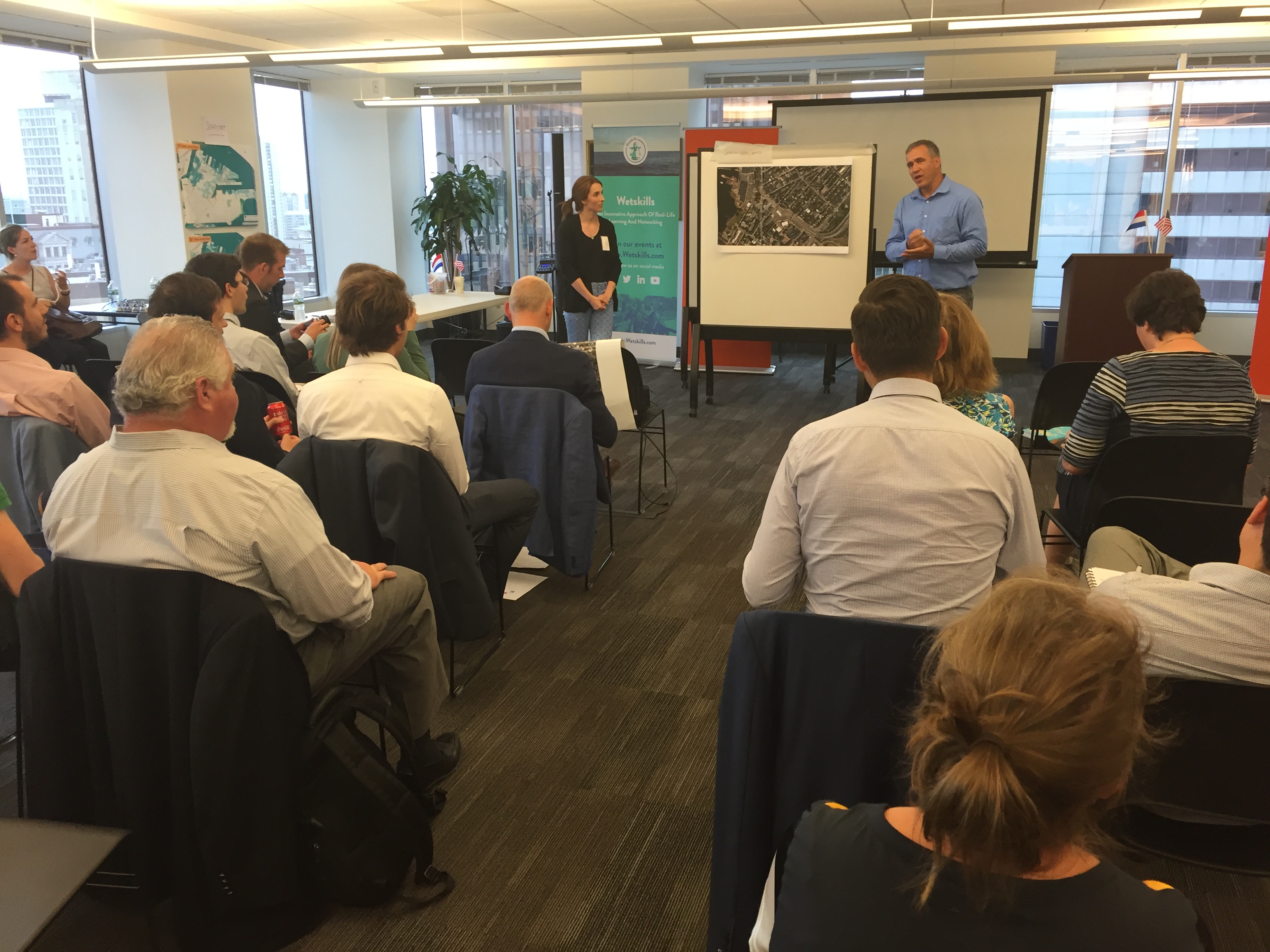
Presenting the findings of the Urban Metabolism Workshop.
The focus at the site scale was the Sumner Tunnel Toll Plaza in East Boston. Situated atop and among a network of former islands connected by landfill, East Boston is a hybrid of 19th and 20th century urban development styles.
The 19th century street grid and low-rise building fabric were adapted in the 20th century to make way for Logan Airport, which is the ninth busiest in the US.
Spurred in part by the development of the airport, a tunnel was built under Boston Harbor to allow for better vehicular connection from the airport in East Boston to the rest of the region. Now, 80 years later, urban planners are redesigning the toll plaza.
Introducing the panel, group leader Chris Marchi from the Neighborhood of Affordable Housing spoke about “improving social resiliency through transportation efficiency.”
The “50-year transportation problem for the neighborhood,” Marchi said, was “the construction of the tunnel.”
Correcting an imbalance
City planning and development often creates imbalances such as this, where regional improvements come at the expense of many aspects of local quality of life.
In the case of the Sumner tunnel, reported Marchi, “this investment made the neighborhood completely unwalkable.”
Marchi worked with Kat Miller, a designer and student at the Harvard Graduate School of Design, to sketch and articulate the issues.
Now, as Massachusetts is in the process of eliminating all toll booths across the entire I-90 network, new urban development and design opportunities are emerging, including the Sumner Tunnel toll plaza in East Boston.
The group acknowledged that the route is a key artery for the airport to downtown. In eliminating the toll plaza, however, the present imbalance between local impact and regional benefit could be corrected if officials use a more holistic process.
The change in toll collection technology could be a tremendous catalyst for this area. By removing the toll booths, a significant amount of space opens for other uses. By engaging local stakeholders in a process to define broader goals for the area, ideas can emerge: economic development, mobility, and environmental quality stand to improve.
Creating a holistic framework
Once a baseline level of awareness is created and shared, consensus strategies can start to form: strengthening the center, improving green space, improving neighborhood connectivity, reducing environmental impacts from stormwater, and reducing traffic.
All of these strategies could be implemented in some form as the space becomes available, and, as the history of the tunnel shows, technology evolves. Is this a once-in-80-years opportunity?
Other ideas that were discussed included:
- Re-creating the commercial corridor along Porter Street that existed in the area before the toll plaza construction.
- Extending tolling all the way to the airport terminals to incentivize taking transit to the airport over driving.
- Creating local and regional Bus Rapid Transit to filter more people from northern and coastal communities to take transit.
- Making the area around the tunnel entrance more walkable.
By creating and applying a more holistic project framework, the local capacity within the community for residents, businesses, and governments to work together can be strengthened.
Greater physical and social resilience in the future demands we build this community capacity in Boston and beyond.
